Showing posts with label hack. Show all posts

Friday, 13 May 2016

Facebook Open Sources its Capture the Flag (CTF) Platform

facebook-capture-the-flag-ctfHacking into computer, networks and websites could easily land you in jail. But what if you could freely test and practice your hacking skills in a legally safe environment?

Facebook just open-sourced its Capture The Flag (CTF) platform to encourage students as well as developers to learn about cyber security and secure coding practices.

Capture the Flag hacking competitions are conducted at various cyber security events and conferences, including Def Con, in order to highlight the real-world exploits and cyber attacks.

The CTF program is an effective way of identifying young people with exceptional computer skills, as well as teaching beginners about common and advanced exploitation techniques to ensure they develop secure programs that cannot be easily compromised.

Facebook  CTF Video Demo:

Since 2013, Facebook has itself hosted CTF competitions at events across the world and now, it is opening the platform to masses by releasing its source code on GitHub.
"We built a free platform for everyone to use that takes care of the backend requirements of running a CTF, including the game map, team registration, and scoring," said Gulshan Singh, Software Engineer at Facebook Threat Infrastructure.

In general, Capture The Flag competition hosts a series of security challenges, where participants have to hack into defined targets and then defending them from other skilled hackers.
"The current set of challenges include problems in reverse-engineering, forensics, web application security, cryptography, and binary exploitation. You can also build your own challenges to use with the Facebook platform for a customized competition," Mr. Singh said.

Many institutions and organizations now have realized that gamification of cyber security and hacking is beyond the traditional ways to train your mental muscles and keep sharp your skills that otherwise only come up when doomsday scenarios happen.

Courtesy: THN

Wednesday, 27 January 2016

Oh Snap! Lenovo protects your Security with '12345678' as Hard-Coded Password in SHAREit


shareit-file-sharing
What do you expect a tech giant to protect your backdoor security with?
Holy Cow! It's "12345678" as a Hard-Coded Password.
Yes, Lenovo was using one of the most obvious, awful passwords of all time as a hard-coded password in its file sharing software SHAREit that could be exploited by anyone who can guess '12345678' password.
The Chinese largest PC maker made a number of headlines in past for compromising its customers security.

It had shipped laptops with the insecure SuperFish adware, it was caught using Rootkit to secretly install unremovable software, its website was hacked, and it was caught pre-installing Spyware on its laptops. Any of these incidences could have been easily prevented.
Now, Research center of Core Security CoreLabs issued an advisory on Monday that revealed several software vulnerabilities in Lenovo SHAREit app for Windows and Android that could result in:
  • Information leaks
  • Security protocol bypass
  • Man-in-the-middle (MITM) attacks

Critical Vulnerabilities in SHAREit

SHAREit is a free file sharing application that is designed to allow people to share files and folders from Android devices or Windows computers over a local LAN or through a Wi-Fi hotspot that's created.
All the vulnerabilities were remotely exploitable and affected the Android 3.0.18_ww and Windows 2.5.1.1 versions of SHAREit.
 
 
Here's the list of four vulnerabilities:
  • Use of Hard-coded Password [CVE-2016-1491]
  • Missing Authorization [CVE-2016-1492]
  • Missing Encryption of Sensitive Data [CVE-2016-1489]
  • Information Exposure [CVE-2016-1490]
The first vulnerability (CVE-2016-1491) would make you scream… How Dare You!

Using '12345678' as Hard Coded Password

Lenovo was using '12345678' as a hard-coded password in SHAREit for Windows that has been awarded the title of the Third Worst Password of 2015 by the password management firm SplashData.
Here's what Core Security researchers explain:
"When Lenovo SHAREit for Windows is configured to receive files, a Wi-Fi HotSpot is set with an easy password (12345678). Any system with a Wi-Fi Network card could connect to that Hotspot by using that password. The password is always the same."
This is ridiculous especially when the passwords in any application are hard-coded and unchangeable by an average user, putting its consumers and their data at risk.

Other Critical Flaws Left Millions of Users at Risk

However, the issue got worse when the second vulnerability (CVE-2016-1492) came into play. In the second flaw, that applied only to SHAREit for Android, an open WiFi hotspot is created without any password when the app is configured to receive files.
This could have allowed an attacker to connect to that insecure WiFi hotspot and capture the data transferred between Windows and Android devices.
This didn't end here. Both Windows and Android were open to the third flaw (CVE-2016-1489) that involved the transfer of files via HTTP without encryption.
This allowed hackers to sniff the network traffic and view the data transferred or perform Man-in-the-Middle (MitM) attacks in order to modify the content of the transferred files.
Finally, the last but not the least, fourth vulnerability (CVE-2016-1490) discovered by CoreLabs relates to the remote browsing of file systems within Lenovo ShareIt and builds upon the default 12345678 Windows password issue reported above.
"When the Wi-Fi network is on and connected with the default password (12345678), the files can be browsed but not downloaded by performing an HTTP Request to the WebServer launched by Lenovo SHAREit," says the advisory.

Patch Now!

The researchers at Core Security privately reported the flaws to Lenovo back in October last year, but the tech giant took three months to patch the flaws.
Patches for both Android as well as Windows phone are made available on the Google Play Store and here, respectively. So, SHAREit users are advised to update their apps as soon as possible.

Wednesday, 18 March 2015

FREAK' — New SSL/TLS Vulnerability Explained

freak-ssl-tls-vulnerability
Another new widespread and disastrous SSL/TLS vulnerability has been uncovered that for over a decade left Millions of users of Apple and Android devices vulnerable to man-in-the-middle attacks on encrypted traffic when they visited supposedly 'secured' websites, including the official websites of the White House, FBI and National Security Agency.

Dubbed the "FREAK" vulnerability (CVE-2015-0204) - also known as Factoring Attack on RSA-EXPORT Keys - enables hackers or intelligence agencies to force clients to use older, weaker encryption i.e. also known as the export-grade key or 512-bit RSA keys.

FREAK vulnerability discovered by security researchers of French Institute for Research in Computer Science and Automation (Inria) and Microsoft, resides in OpenSSL versions 1.01k and earlier, and Apple's Secure Transport.

90s WEAK EXPORT-GRADE ENCRYPTION
Back in 1990s, the US government attempted to regulate the export of products utilizing "strong" encryption and devices were loaded with weaker "export-grade" encryption before being shipped out of the country.

At that time, it was allowed a maximum key length of 512 bits for "export-grade" encryption. Later in 2000, with the modification of the US export laws, vendors were able to include 128-bit ciphers in their products and were able to distribute these all over the world.

The only problem is that "export-grade" cryptography support was never removed and now three decades later, FREAK vulnerability make it significantly easier for hackers to decode the website’s private key and decrypt passwords, login cookies, and other sensitive information from HTTPS connections.

HOW FREAK VULNERABILITY WORKS ?
Assistant Research Professor Matthew Green of Johns Hopkins University's Information Security Institute in Maryland summarizes the FREAK vulnerability in ablog post detailing how a hacker could perform MitM attack:
  • In the client's Hello message, it asks for a standard 'RSA' ciphersuite.
  • The MITM attacker changes this message to ask for 'export RSA'.
  • The server responds with a 512-bit export RSA key, signed with its long-term key.
  • The client accepts this weak key due to the OpenSSL/Secure Transport bug.
  • The attacker factors the RSA modulus to recover the corresponding RSA decryption key.
  • When the client encrypts the 'pre-master secret' to the server, the attacker can now decrypt it to recover the TLS 'master secret'.
  • From here on out, the attacker sees plain text and can inject anything it wants.
36% SSL WEBSITES VULNERABLE TO HACKERS
nsa-fake-ssl
A scan of more than 14 million websites that support the SSL/TLS protocols found that more than 36% of them were vulnerable to the decryption attacks that support RSA export cipher suites (e.g., TLS_RSA_EXPORT_WITH_DES40_CBC_SHA).

Cracking a 512-bit key back in the '90s would have required access to supercomputers of that time, but today, it can be done in seven hours and cost nearly $100 per website only.

It is possible to carry out FREAK vulnerability attack when a user running a vulnerable device — currently includes Android smartphones, iPhones and Macs running Apple's OS X operating system — connects to a vulnerable HTTPS-protected website. At the moment, Windows and Linux end-user devices were not believed to be affected.

'FREAK' VULNERABILITY SIMILAR TO 'POODLE'
FREAK vulnerability is similar to last year's POODLE flaw or Padding Oracle On Downgraded Legacy Encryption, which allowed hackers to downgrade the entire SSL/TLS Internet-communication security suite to the weakest possible version. FREAK affects only those SSL/TLS implementations that accept export versions of protocols that use the RSA encryption algorithm.
Online SSL FREAK Testing Tool
Security researchers are maintaining a list of top vulnerable websites and encourage web server administrators to disable support for export suites, including all known insecure ciphers, and enable forward secrecy.

You can also use an Online SSL FREAK Testing Tool to check whether a website is vulnerable or not.

APPLE AND GOOGLE PLANS TO FIX FREAK
Google said an Android patch has already been distributed to partners. Meanwhile, Google is also calling on all websites to disable support for export certificates.

Apple also responded to the FREAK vulnerability and released a statement that, "We have a fix in iOS and OS X that will be available in software updates next week."

Courtesy: THN

Monday, 1 December 2014

Crash Your Friends' WhatsApp Remotely with Just a Message


WhatsApp Remote Crashing Vulnerability
A Vulnerability has been discovered in the wildly popular messaging app WhatsApp, which allows anyone to remotely crash WhatsApp just by sending a specially crafted message, two security researchers reported ‘The Hacker News’.

Two India based independent security researchers, Indrajeet Bhuyan and Saurav Kar, both 17-year old teenagers demonstrated the WhatsApp Message Handler vulnerability to one of our security analyst.

In a video demonstration, they showed that by sending a 2000 words (2kb in size) message in special character set can crash the receiver's app. The worried impact of the vulnerability is that the user who received the specially crafted message will have to delete his/her whole conversation and start a fresh chat, because opening the message keeps on crashing WhatsApp unless the chat is deleted completely.
"What makes it more serious is that one needs to delete entire chat with the person they are chatting to in order to get back whatsapp work in normal," Bhuyan told THN in an e-mail.
According to the duo, the reported vulnerability has been tested and successfully works on most of the versions of Android Operating system including Jellybean, Kitkat, and all the below android versions.

Similarly, Any member of your WhatsApp group could intentionally send a specially crafted message to exit people from the group and delete the group. Also, for example, if I don’t want someone to keep records of my chat with them, then I can also send the same message exploit to the person.

The vulnerability has not been tested on iOS, but it is sure that all versions of WhatsApp including 2.11.431 and 2.11.432 are affected with this bug. Also the attack does not work on Windows 8.1.
They have also provided the Proof-of-Concept (PoC) video for the attack, users can watch above.

WhatsApp, bought by Facebook for $19 billion in February this year, has 600 Million users as of October 2014, and according to the researchers, an estimated number of users affected by the vulnerability could be 500 Million.

WhatsApp was in news recently for making end-to-end encryption on all text messages as a default feature in an effort to boost the online privacy and security of its users around the world. The app maker describe this move as the "largest deployment of end-to-end encryption ever."

Sunday, 18 May 2014

Card Control app helps users protect their credit cards from hacking

card_control_app_screenshot_ndtv_ondot.jpg

Bad news for credit card hackers. Here comes a 'remote control' app that can help users turn their credit cards on and off with the click of a button, and also control when, where, and how they are used.Run by two Indian American entrepreneurs, a San Jose-based startup called OnDot Systems has unveiled an app named Card Control, which acts as a kind of 'remote control' for credit, debit, and prepaid cards.
The app requires no external hardware and no special credit cards.
"We sells Card Control directly to banks and credit card processors who offer it as a special service to their customers. OnDot collects a per-user licensing fee from the banks and processors," Rachna Ahlawat, CEO, OnDot was quoted as saying.
Selling directly to institutions and not to individuals was a careful decision, Vaduvur Bharghavan, founder of the company, noted.
"We tell the banks to offer this to your customers as a convenience," Bharghavan added.
OnDot has signed deals with four major credit card processors, who collectively process transactions for 10,000 banks and credit unions across the country, a report in wired.com said.
According to Verizon's 2014 Data Breach Investigations Report (DBIR), 2013 can be termed at the year of retailer breach and can also be considered as the year of transition from geopolitical attacks to large-scale attacks on payment card systems.
Verizon's DBIR report added that financially motivated attackers are hyper-focused on gaining access to the money, so it follows that their two primary target industries are the financial and retail industries (where data that easily converts to money is abundant and all too often, accessible).
"Within the financial industry, they focus on gaining access to the user interface of the web (banking) application more so than exploiting the web application itself, because the application grants logical access to the money. "This means they target user credentials and simply use web applications protected with a single factor (password) as the conduit to their goal," the report added.

Wednesday, 14 May 2014

Bitly website hacked, accounts credentials compromised


Bitly(bit.ly), the Popular URL shortening service, has issued an urgent security warning about a security breach that exposed account's credentials.

The company says they found no evidence suggesting that any accounts have been accessed by the intruders.  However, as a precaution, the company has disconnected users' facebook and twitter accounts.

"We invalidated all credentials within Facebook and Twitter" the blog post reads.

Although the social media accounts appear to be connected with bitly account,  users won't be able to publish anything until they reconnect the accounts. 

Users are advised to take the following steps to reset their OAuth tokens and API Keys:

1) Log in to your account and click on ‘Your Settings,’ then the ‘Advanced’ tab.

2) At the bottom of the ‘Advanced’ tab, select ‘Reset’ next to ‘Legacy API key.’

3) Copy down your new API key and change it in all applications. These can include social publishers, share buttons and mobile apps.

4) Go to the ‘Profile’ tab and reset your password.

5) Disconnect and reconnect any applications that use Bitly. You can check which accounts are connected under the ‘Connected Accounts’ tab in ‘Your Settings.’
Bitly says "they have already taken proactive measures to secure all paths that led to the compromise". 

Friday, 21 March 2014

Windows Spy tool equipped with Android malware to hack Smartphones

Windows Spy tool equipped with Android malware to hack Smartphones
I am quite sure that you must be syncing your Smartphone with your Computers for transferring files and taking backup of your device.
If you are using windows operating system and Android devices, then it’s a bad news for you, because FireEye Security Researchers have identified a new piece of windows malware that can also infects your Android Devices.
During an investigation of a targeted attack on a US based financial institution, researchers spotted a new version of Windows Remote Access Trojan (RAT) called 'Win-Spy Software Pro v16', a spying and monitoring tool. WinSpy was embedded in macro documents to kick off a spam campaign via a spear phishing email.
“The recent surge in Android-based RATs such as Dendroid and AndroRAT shows a spike in the interest of malicious actors to control mobile devices. GimmeRAT is another startling example of malicious actors venturing into the Android ecosystem,” security firm said.

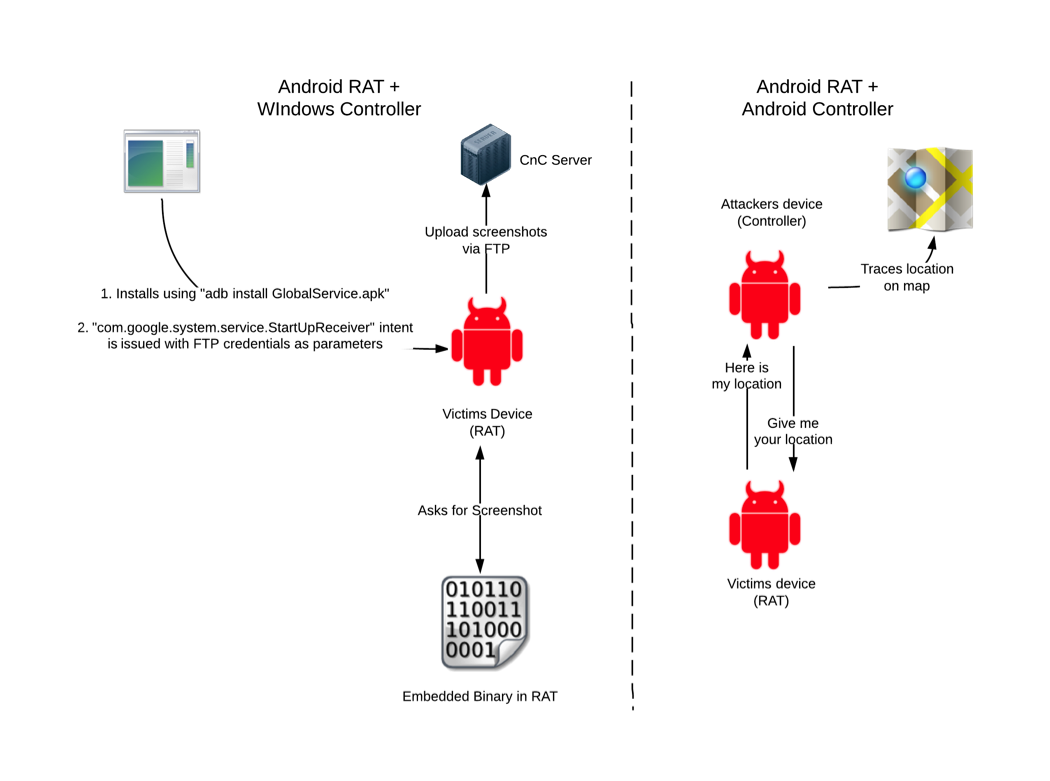
The Researchers dubbed the Android spying component pre-loaded with WinSpy as GimmeRat, that allow hackers to control the victims’ device by using their own phone remotely over SMSs, or alternatively through a Windows-based controller.
"We also discovered various Android components that can be employed to engage in surveillance of a target."  security firm said in a blog post.
Windows Spy tool equipped with Android malware to hack Smartphones
To install the Android malware, WinSpy communicates with mobile devices connected to the infected computer using a command line tool called Android Debug Bridge (ADB), that allows the Windows malware to execute commands on the Android device. ADB is a legitimate tool and part of the official Android software development kit (SDK). If USB debugging Mode is enabled on the device, it initiates the installation process.

The new Android components also smooth the ways for surveillance of the target and there are three different applications that are part of the Android surveillance package.

“We have found three different applications that are a part of the surveillance package. One of the applications requires commandeering via a window controller and requires physical access to the device while the other two applications can be deployed in a client-server model and allow remote access through a second Android device,” wrote the researchers.
The technique is now new, Similar payload was used by other windows malware called ‘Trojan.Droidpak’ to infect Android Device, that was discovered by Antivirus firm Symantec in January.
Using Android malware, the attackers could trace victims’ GPS location, can take screenshots of victims’ devices and could send these data to the remote Command-and-Control servers. Trojan is also perfect in monitoring the device' text messages.
"The hostname, port, username, and password are used to connect to the attackers’ FTP server to send screenshots, which is explained, in a later section. Once this intent is received the GlobalService is restarted with the interval parameter.." FireEye said.
Windows Spy tool equipped with Android malware to hack Smartphones

When Windows system infected with WinSpy, an attacker can take screenshots, log keystrokes and even can also use it to open a backdoor for remote commands, upload and download of more files and the execution of remote commands.
With the widespread use of Smartphones, the adoption of the mobile platforms such as Android has been increased, and so the new market of cyber criminals demands for RATs to support these platforms. Such interesting tactics can be used to serve fake Mobile Banking apps.. Fairly evil Ideas!

Popular Posts