Showing posts with label NSA. Show all posts

Wednesday, 16 December 2015

GHCQ opensources its large scale database Software

 
Open-Source-large-scale-database
UK's Secretive Spy Agency Government Communications Headquarters (GCHQ) has open-sourced one of its tools on code-sharing website GitHub for free...
A graph database called 'Gaffer.'
Gaffer, written in Java, is a kind of database that makes it "easy to store large-scale graphs in which the nodes and edges have statistics such as counts, histograms and sketches."
Github is a popular coding website that allows software developers to build their project on a single platform equipped with all the requirements that are gone in the making of a software.

Gaffer and its Functionalities

In short, Gaffer is a framework for creating mass-scale databases, to store and represent data, and is said to be useful for tasks including:

  • Allow the creation of graphs with summarised properties within Accumulo with a very less amount of coding.
  • Allow flexibility of stats that describe the entities and edges.
  • Allow easy addition of nodes and edges.
  • Allow quicker retrieval of data on nodes of interest.
  • Deal with data of different security levels – all data has a visibility, which is used to restrict who can access data based on their authorizations.
  • Support automatic age-off of data.
Gaffer actually uses the Apache Accumulo codebase that was originally open-sourced by the US National Security Agency (NSA) and is released under the Apache 2.0 licence.


Why GCHQ Open Sourced its Code?


It's pretty unusual for one of the most secretive intelligence agencies to release computer code online for anyone to use for free.
Because GCHQ is very well known for monitoring communications worldwide and is not at all expected to release its database types open source on GitHub.
However, maybe this GCHQ's move is part of its effort toward becoming friendlier in the hacker community and to attract new talents.
The spy agency also says that it is already started working on Gaffer2, a project the agency aims to take "the best parts of Gaffer... to create a more general purpose graph database system."
What do you think about this GCHQ's move? Feel free to tell us by hitting the comments below.

Monday, 11 August 2014

Researchers Uncover Spying Tool Used by Governments to Hijack all Types of Smartphones


Purchasing malware to victimize people is illegal by laws but if the same thing any government official do, then its not!! Yes, the police forces around the World are following the footsteps of U.S. National Security Agency (NSA) and FBI.

Researchers from the Citizen Lab at the Munk School of Global Affairs at the University of Toronto and computer security firm Kaspersky Lab have unearthed a broad network of controversial spyware which is specially designed to give law enforcement agencies complete access to a suspect's phone for the purpose of surveillance.

MALWARE FOR DESKTOPS AND ALL MOBILE DEVICES
mobile hacking tool
The malware, dubbed as Remote Control System (RCS), also known as Da Vinci and Galileo, is developed by an Italian company known as Hacking Team, available for desktop computers, laptops, and mobile devices. The latest version of the malware works for all phone including Android, iOS, Windows Mobile, Symbian and BlackBerry devices, but best on Android devices, and can also be installed on jailbroken iOS devices. But even if the targeted iOS device is not jailbroken, the malware uses the famous Evasi0n jailbreaking tool to install the malware easily.

The team of researchers from both Citizen Lab and Kaspersky Lab in collaboration has presented their findings during an event in London. According to the report published, the diameter of the command infrastructure supporting Hacking Team, which sells the RCS to governments and law enforcement, is very vast with 326 command-and-control (C&C) servers running in more than 40 countries.


MALWARE DEVELOPERS - ‘HACKING TEAM’
Hacking Team is a Milan-based IT company with more than 50 employees that has made a totally different place for itself selling "offensive" intrusion and surveillance software to governments and law enforcement agencies in "several dozen countries" on "six continents."

“It was a well-known fact for quite some time that the HackingTeam products included malware for mobile phones. However, these were rarely seen,” said Kaspersky Lab experts on the blog post. “In particular, the Android and iOS Trojans have never been identified before and represented one of the remaining blank spots in the story.”

WORLD WIDE WEB OF COMMAND-N-CONTROL SERVERS
hackingteam
Kaspersky Lab researchers have used a fingerprinting method to scan the entire IPv4 space and to identify the IP addresses of RCS Command & Control servers around the world and found the biggest host in United States with 64 counts of C&C servers. Next on the list was Kazakhstan with 49, Ecuador has 35, UK which hosts 32 control systems and many other countries with a grand total of 326 Command & Control servers.
"The presence of these servers in a given country doesn't mean to say they are used by that particular country's law enforcement agencies," said Sergey Golovanov, principal security researcher at Kaspersky Lab. "However, it makes sense for the users of RCS to deploy C&Cs in locations they control – where there are minimal risks of cross-border legal issues or server seizures."
ATTACK VECTOR AND MALWARE FEATURES
RCS can be physically implanted on the victim’s device through a USB or SD card, and remotely it can be installed through spear phishing, exploit kits, drive-by downloads or network traffic injection.

Once installed on Apple iOS and Android device, the new module enable governments and law enforcement officers with larger capabilities to monitor victim devices, including the ability to:
  • control phone network
  • steal data from their device
  • record voice E-mail
  • intercept SMS and MMS messages
  • obtain call history
  • report on their location
  • use the device’s microphone in real time
  • intercept voice and SMS messages sent via applications such as Skype, WhatsApp, Viber, and much more.
"Secretly activating the microphone and taking regular camera shots provides constant surveillance of the target—which is much more powerful than traditional cloak and dagger operations," Golovanov wrote.
While, the Android module is protected by an optimizer for Android called DexGuard that made the it extremely difficult to analyze. However, most of the iOS capabilities mentioned above are also available for Android, along with the support for hijacking applications such Facebook, Google Talk, Tencent of China and many more.

The mobile modules for each are custom-built for each target, researchers said. From previous disclosures we have seen that RCS is currently being used to spy on political dissidents, journalists, human rights advocates, and opposing political figures.

End-to-End Encryption for Yahoo Mail Coming Next Year

Yahoo End to End Encryption
Today at Black Hat 2014 hacking conference, Yahoo! Chief Information Security Officer Alex Stamos announced that the company will start giving its consumers the option of end-to-end encryption in its Mail service by next year.

Google showed off a PGP-based encryption plugin for Gmail back in June. The Purple-hued company will offer encryption via a modified version of the same End-to-End browser plug-in that Google uses for PGP in Gmail, Alex Stamos told the audience at his talk titled Building Safe Systems at Scale - Lessons from Six Months at Yahoo.

The PGP plugin will be native in mobile apps allowing Gmail and Yahoo mail to easily exchange encrypted email. Infact, the email providers themselves won’t be able to decrypt messages exchanged between its users. Only senders and recipients will be able to read the messages.
In short, it means that Yahoo email users can reportedly send safe and secure messages between Yahoo users and also Gmail adherents without fear, which makes almost impossible for cyber criminals and well-resourced spying by the US government and its Five Eyes allies to read their private messages.
In a talk today, Stamos said, “If an activist in Sudan wants to email a human rights organization’s Gmail address and they have encryption set up for it, it will automatically detect that and offer them the option to encrypt.”
Stamos (@alexstamos) said that this project has been a priority since he joined one of the world's largest web providers, Yahoo six months ago. He stressed that Yahoo email encryption will be easy to use, with little or no efforts.

The announcement was tweeted by Yan Zhu, who has reportedly been hired to assist in the project. Yan Zhu formerly worked as an engineer at the Electronic Frontier Foundation (EFF), a non-profit organization that has consistently been outspoken in its call for the widespread use of encryption across the Web and the Internet, and he is apparently no friend of the NSA.

But as said earlier, use of encryption will require some amount of education for users also, to make sure their privacy expectations are set appropriately. In an interview with the Wall Street Journal, Stamos explained that PGP encryption won’t cloak the destination of your e-mail.
"We have to make it clear to people it is not [a] secret you’re emailing your priest, but the content of what you’re e-mailing him is secret," Stamos said.
The move to encrypted mail will bring Yahoo! in the list of the most secure technology companies in mail services among web giants, Google and Microsoft that protect their customers in the post-Snowden era of security.

Sunday, 18 May 2014

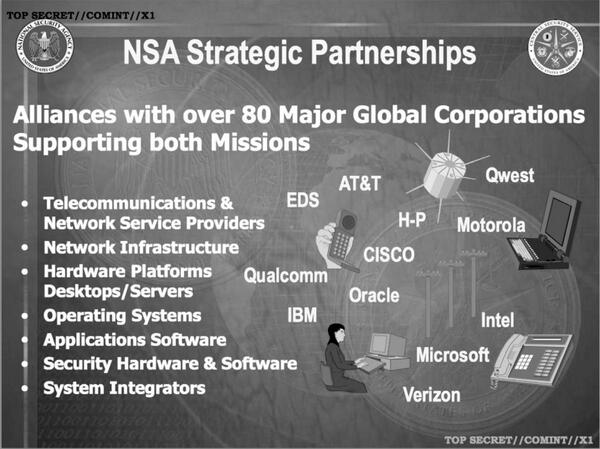
WikiLeaks: About 80 Companies Cooperating With NSA; Intel, IBM, Microsoft Included

As if the Snowden revelations were not enough, we have yet another startling claim by WikiLeaks stating that nearly a hundred corporations colluded with NSA in its surveillance programs.
The tweet from WikiLeaks says,
“80 corporations have been bribed or coopted by NSA including Intel, CISCO, IBM, Oracle, Microsoft, AT&T, Qualcom”
The WikiLeaks have got hold of some NSA documents that has names of the corporations that collaborated with the intelligence agencies to snoop on digital data.
Image credit: PBS
Image credit: PBS
The obtained slides state about 80 ‘Major Global Corporations’ are supporting BOTH missions; however, there is no clear indication as to what ‘both missions’ stand for.
Taking a lead from the cue that the slide is labeled as COMINT, it can be safely inferred that ‘Both’ refer to communications between people.
Some of the listed companies include well-known global organizations, such as Telecommunications and Network Service Providers – AT&T, Verizon and Qwest (now part of Centurylink); Network Infrastructure – Cisco and HP; Hardware Platforms Desktops/Servers – HP, Intel, Qualcomm, IBM, EDS (now HP); Operating Systems – Microsoft; Applications Software – Oracle, EDS (now HP) and Microsoft; Security Hardware and Software – Cisco, Oracle, EDS (now HP); System Integrators – HP, IBM, Cisco and EDS (now HP)
This is the first time ever a documented list of company names engaged with NSA has been highlighted.
These companies had earlier refuted charges of working in collusion with the intelligence agencies when NSA’s PRISM activities were disclosed. Some of them even alleged being victimized or attacked by the government for refusing to cooperate with the intelligence agencies.
HackRead has many articles on companies–NSA association: refusal and charges.
While the information made public by WikiLeaks only corroborates the common men’s suspicion about the NSA and corporations working together, it is bit intriguing that WikiLeaks has not made public the full list of organizations. WikiLeaks is notoriously famous for making documents public that shames the US government.

Friday, 21 March 2014

Back off, NSA! Gmail now Encrypts every single Email

Back off, NSA! Gmail now Encrypts every single Email
2014 - The Year for Encryption! Good News for Security & Privacy seekers, Gmail is now more secure than ever before.
Google has announced that it has enhanced encryption for its Gmail email service to protect users from government cyber-spying; by removing the option to turn off HTTPS.

So from today, Gmail will always use an encrypted HTTPS connection by default when you check or send email. Furthermore, Google also assured that every single email message will now be encrypted as it moves internally between the company's data centers.
"Today's change means that no one can listen in on your messages as they go back and forth between you and Gmail’s servers—no matter if you're using public WiFi or logging in from your computer, phone or tablet." Nicolas Lidzborski, Gmail Security Engineering Lead said in a blog post.
It was previously disclosed by Edward Snowden that the National Security Agency (NSA) is intercepting email messages as they move between data centers and servers using controversial PRISM data mining program. 
Google has finally realized that it makes no sense to allow unencrypted HTTP connections. "Our commitment to the security and reliability of your email is absolute, and we’re constantly working on ways to improve." he said.
Does this mean your Gmail messages are now fully secure from government snooping? NSA is still out there!

Monday, 24 February 2014

Silent Circle's Blackphone - A $629 Privacy and Security Focused Smartphone

Silent Circle Blackphone buy
Earlier this year encrypted communications firm Silent Circle and Spanish Smartphone makerGeeksphone announced a privacy-focused encrypted Smartphone called 'Blackphone' and today the company has revealed it as 'Mobile World Congress' in Barcelona.

The Blackphone titled as, “world’s first Smartphone which places privacy and control directly in the hands of its users,” has a fully customized version customized version of Android called PrivatOS and pre-installed with lots of privacy-enabled applications, is now available for pre-order for about $629.

Silent Circle was co-founded by a respected Cryptographer Phil Zimmermann, best known as the creator of Pretty Good Privacy (PGP), which is a widely used email encryption software.

The Blackphone handsets main focus is keeping all of your data secure, and to stop government agencies snooping on your communications. Blackphone will come with a set of application developed by Silent Circle, including Silent Phone, Silent Text, and Silent Contacts as well as other features for firewall and remote wipe when required.
Silent Circle Blackphone
Blackphone also has a 'Kismet Smart Wi-Fi Manager' to improve the security device on public networks, and also provides the private web browsing and secure file-sharing options. The Android-based Blackphone is powered by a quad-core 2 GHz processor, 2GB of RAM, 16GB of onboard storage and support for LTE networks.

The Blackphone also comes with SpiderOak, which provides 5GB of encrypted data backup, and Virtual Private Network from Disconnect.me.

But if you think 'Blackphone' is a shield against the NSA or other intelligence agencies Blackphone, then you should know this - Blackphone cannot mask metadata entirely from NSA. No piece of man-made technology is entirely hack-proof.

Mike Janke, co-founder and CEO of Silent Circle told Mashable, "If you are on the terrorist wanted list or a criminal, intelligence services will get into your device... There's no such thing as 100% secure phone."

The Blackphone’s main security feature is voice and text encryption, not about hiding metadata which is related to a communication data such as date, time, location and identity of the users.

Popular Posts